
Search is changing faster than ever. People are no longer relying only on traditional Google search results to find information, products, and services. AI-powered platforms such as ChatGPT, Google AI Overviews, Gemini, and Perplexity are becoming an important part of how users discover answers online.
For businesses, this creates a new search visibility challenge.
It is no longer enough to know whether a website ranks for a particular keyword. Businesses also need to understand whether their brand appears when potential customers ask relevant questions to AI-powered search platforms.
This is where Answer Engine Optimization (AEO) comes into the picture.
AEO focuses on making content easier for answer engines and AI systems to understand, extract, reference, and potentially cite when generating responses to user queries.
But improving AEO performance requires measurement. Businesses need to know where their brand appears, how often competitors are mentioned, which pages are being referenced, and what questions trigger their visibility.
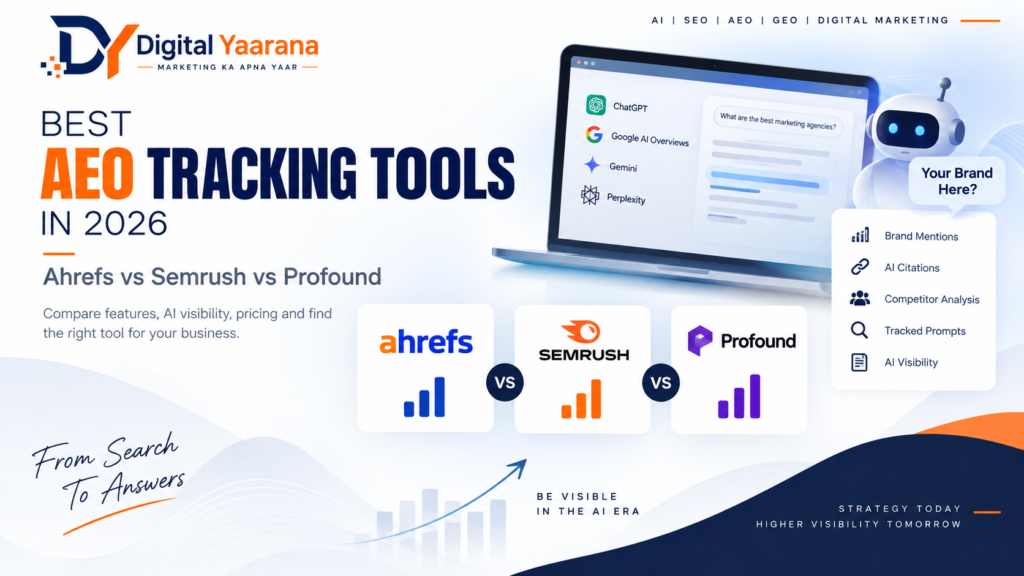
Several platforms now provide AI visibility and AEO tracking capabilities. Common options include Ahrefs, Semrush, and Profound.
In this guide, we will look at how these platforms approach AEO tracking, what they can monitor, and which businesses may benefit from each tool.
What Is AEO Tracking?
Traditional SEO tracking focuses on metrics such as keyword rankings, organic traffic, impressions, clicks, backlinks, and search visibility.
AEO tracking looks at search from a different perspective.
Instead of asking:
Where does my website rank for this keyword?
AEO tracking asks:
Does my brand appear when users ask AI-powered search platforms questions related to my business?
For example, a digital marketing agency may traditionally track keywords such as:
digital marketing agency in India
SEO agency in Noida
AI SEO agency India
With AEO tracking, the agency may also monitor questions such as:
Which are the leading digital marketing agencies in India?
What is the best way to improve SEO for an Indian business?
Which agencies provide AEO and GEO services?
The objective is to understand how AI-generated answers represent the brand and its competitors.
Why AEO Tracking Is Important
AI search visibility is different from traditional rankings.
A website can rank on the first page of Google and still receive little or no visibility inside an AI-generated answer.
Similarly, a website that does not rank in the traditional top positions may still be referenced by an AI system because its content provides useful, relevant, and trustworthy information.
AEO tracking helps marketers identify these differences.
It can help businesses monitor brand mentions, citations, competitors, tracked prompts, source pages, and changes in AI visibility.
For companies investing in AEO and GEO, this information can provide another layer of performance data alongside traditional SEO metrics.
Ahrefs for AEO Tracking
Ahrefs is widely used for traditional SEO activities such as keyword research, backlink analysis, competitor research, content analysis, and site audits.
Its Brand Radar product extends the platform into AI visibility monitoring. Ahrefs describes Brand Radar as a way to analyze brand visibility, mentions, citations, competitors, and sources across AI search experiences.
What Can You Monitor With Ahrefs?
Ahrefs Brand Radar can be used to investigate areas such as brand mentions, AI citations, AI share of voice, competitors, cited domains, cited pages, and custom prompts.
This makes it useful for SEO teams that want to connect traditional search data with AI search visibility.
For example, an SEO team could compare its traditional organic performance with how frequently the same brand is mentioned in AI-generated responses.
Why Ahrefs Can Be Useful for AEO
One of the main advantages is that businesses already using Ahrefs for SEO can incorporate AI visibility analysis into an existing workflow.
This can make reporting easier because SEO teams can work with familiar competitor and search data while also investigating AI visibility.
Ahrefs is particularly relevant for agencies, enterprise SEO teams, and businesses that already depend heavily on the Ahrefs ecosystem.
Semrush AI Visibility Toolkit
Semrush has also expanded its SEO platform into AI search visibility.
Its AI Visibility Toolkit is designed to help marketers monitor brand visibility across AI-powered search experiences. Semrush currently highlights monitoring for platforms including ChatGPT, Google AI, Gemini, and Perplexity.
The toolkit provides capabilities around AI visibility, competitors, prompts, brand performance, and AI search analysis.
What Does Semrush Track?
Depending on the plan and configuration, marketers can investigate:
- AI brand visibility
- Tracked prompts
- Competitor mentions
- AI-generated responses
- Prompt research
- Brand performance
- AI search insights
This makes Semrush useful for businesses that already use its broader SEO and digital marketing platform.
For example, an SEO manager can research traditional keywords in Semrush and then investigate related AI prompts to understand whether the brand is appearing in conversational search experiences.
Semrush for Agencies
Semrush can be especially useful for agencies managing multiple SEO activities for clients.
Traditional SEO reporting can include rankings, traffic, backlinks, and technical health, while AI visibility reporting can add another layer focused on how the client’s brand appears in AI-generated responses.
Profound for AEO and AI Search Visibility
Profound approaches the problem from a more specialized AI-search perspective.
Rather than being primarily known as a traditional SEO platform, Profound focuses heavily on AI search visibility and answer-engine monitoring.
Its platform is designed to help organizations understand how their brands appear in AI-generated answers and how those answers compare with competitors.
What Does Profound Offer?
Profound provides capabilities around AI visibility, prompt tracking, answer engine monitoring, competitive analysis, and AEO-related insights.
This makes it relevant for businesses that treat AI search as a dedicated marketing channel rather than simply an extension of traditional SEO.
Profound’s current pricing page lists a Starter plan at $99 per month and a Growth plan at $399 per month, while enterprise pricing is customized. Features and pricing can change, so businesses should verify the current plan before purchasing.
Ahrefs vs Semrush vs Profound
The three platforms approach AEO tracking from slightly different directions.
| Feature | Ahrefs | Semrush | Profound |
|---|---|---|---|
| AI Visibility Tracking | Yes | Yes | Yes |
| Brand Mentions | Yes | Yes | Yes |
| AI Citations | Yes | Yes | Yes |
| Competitor Analysis | Yes | Yes | Yes |
| Prompt Tracking | Yes | Yes | Yes |
| Traditional SEO | Extensive | Extensive | More specialized |
| AI Search Focus | Strong | Strong | Dedicated |
| Suitable for Agencies | Yes | Yes | Yes |
| Suitable for Enterprise | Yes | Yes | Yes |
The right choice depends on how your team currently manages SEO and how deeply you want to integrate AI search monitoring into your workflow.
What Metrics Should You Track With AEO Tools?
Choosing an AEO platform is only the first step. The real value comes from understanding the data.
Brand Mentions
Brand mentions show how frequently your business appears in AI-generated responses for relevant questions.
Tracking mentions over time can help identify whether your visibility is increasing or decreasing.
AI Citations
Citations are another important part of AI search visibility.
A citation indicates that a platform has referenced a website or source while generating an answer.
For businesses, tracking citations can help identify which pages and content assets are being used as supporting sources.
Competitor Mentions
AEO tracking should not focus only on your own brand.
Competitor monitoring can reveal which businesses appear for the same questions and topics.
For example, if your brand is rarely mentioned for a particular commercial query while several competitors appear consistently, that can indicate an opportunity to improve content and authority around that topic.
Share of Voice
AI share of voice can help businesses understand their visibility relative to competitors across a defined set of prompts.
This is particularly useful for agencies and larger brands that want to monitor a specific group of commercial and informational queries.
Source Pages
Understanding which pages are being referenced can provide valuable content insights.
If certain pages consistently appear as sources, marketers can study what makes those pages useful and apply similar principles to other content.
How AEO Tracking Works With Traditional SEO
AEO should not be treated as a complete replacement for SEO.
Traditional SEO remains important because search engines and AI-powered search experiences still depend on discoverable, accessible, and useful information.
A modern search strategy can therefore combine traditional SEO with AEO and GEO.
Traditional SEO focuses on technical optimization, keyword targeting, content quality, internal linking, backlinks, website architecture, and organic rankings.
AEO focuses more heavily on direct answers, conversational queries, structured information, entities, topical authority, and AI visibility.
GEO focuses on improving the likelihood that content and brand information can be understood and represented within generative search experiences.
Together, these approaches create a broader search optimization strategy.
How to Build an AEO Tracking Strategy
Before opening an AEO tracking platform, businesses should define exactly what they want to measure.
Start by identifying the questions your target customers are likely to ask.
For example, a digital marketing agency might monitor questions around SEO, PPC, local SEO, AI SEO, AEO, GEO, web development, and lead generation.
The next step is to create a group of relevant prompts.
These prompts should represent different stages of the customer journey.
Informational prompts can help measure educational visibility.
Commercial prompts can reveal brand and competitor visibility.
Local prompts can measure visibility for location-specific searches.
Service-specific prompts can show whether the brand is being associated with its core offerings.
Once the prompts are defined, monitor them consistently instead of checking AI responses only occasionally.
AEO Tracking for Local Businesses
AEO tracking is not limited to large national brands.
Local businesses can also monitor AI visibility.
For example, a dental clinic could track questions such as:
Which dental clinics are available in Noida?
Where can I find a cosmetic dentist in Noida?
What should I consider when choosing a dental clinic?
Similarly, restaurants, hospitals, real estate companies, education providers, and local service businesses can create industry-specific prompt sets.
Local SEO signals, business information, reviews, website content, and third-party references can all contribute to the broader online presence that users and AI systems encounter.
Common AEO Tracking Mistakes
One common mistake is tracking only brand mentions.
A brand may appear frequently, but marketers should also understand why it appears and which sources are associated with those answers.
Another mistake is monitoring too few prompts.
A handful of questions may not provide enough information to understand overall AI visibility.
Businesses should also avoid treating one AI response as a permanent ranking.
AI-generated answers can change based on the query, context, location, platform, available sources, and system updates.
AEO should therefore be treated as an ongoing measurement and optimization process.
How Digital Yaarana Uses AEO as Part of AI SEO
At Digital Yaarana, AEO is part of a broader AI-first search strategy.
The agency’s AI SEO approach covers AIO, AEO, and GEO with the goal of improving visibility across traditional search and AI-powered search experiences. Its website specifically highlights optimization for Google AI Overviews, ChatGPT, Gemini, Perplexity, and other AI search environments.
AEO tracking can support this process by providing visibility into how a brand is represented in AI-generated answers.
Instead of focusing only on rankings, businesses can monitor their brand mentions, competitor presence, citations, relevant prompts, and content sources.
This data can then be used to identify content gaps and optimization opportunities.
Which AEO Tracking Tool Should You Choose?
The right platform depends on your existing marketing stack and objectives.
If your team already uses Ahrefs, Brand Radar can extend your existing SEO workflow into AI visibility monitoring.
If your organization already works extensively with Semrush, its AI Visibility Toolkit can connect AI search analysis with a broader SEO and marketing workflow.
If your primary focus is AI search and answer-engine visibility, Profound provides a more specialized environment for monitoring this area.
Rather than choosing a platform purely because of its feature count, consider the number of prompts you need to track, competitors you need to monitor, AI platforms relevant to your audience, reporting requirements, and how the tool fits into your existing SEO process.
Final Thoughts
The evolution of search means that businesses now need to look beyond traditional keyword rankings.
Google rankings, organic traffic, backlinks, and conversions remain important, but AI-generated answers are creating another layer of search visibility that marketers need to understand.
Ahrefs, Semrush, and Profound provide different approaches to monitoring this emerging area.
The most effective AEO strategy is not simply about getting a brand mentioned by an AI platform. It is about creating useful, authoritative, structured, and trustworthy information that can be understood across modern search experiences.
By combining traditional SEO with AEO, GEO, technical optimization, content strategy, entity building, and continuous monitoring, businesses can build a stronger foundation for the changing search landscape.
Digital Yaarana helps businesses adapt to this AI-first search environment through SEO, AI SEO, AEO, GEO, content marketing, and digital marketing strategies designed around measurable business growth.